
Ingredient Guide
What common men's health ingredients are, what they are traditionally used for, and how to read a label before you buy.

Why this guide exists
Most men's formulas hide their ingredients in small print
Walk into any shop in Bandung and you will find shelves of bottles promising energy, stamina and focus. What separates them is rarely the marketing on the front. It is the ingredient panel on the back: which herbs are listed, how much of each one is actually inside, and whether the numbers line up with the serving size printed at the top.
This page walks through the ingredients you will see again and again in natural supplements for men's health, explains what each one is traditionally associated with, and shows you how to compare two bottles side by side without needing a background in nutrition. Nothing here is medical advice. Think of it as a reading guide for labels.
The ingredient table
Each row below covers one ingredient you will meet on a men's health label: what it is, the amount typically seen in a daily serving, and what it is traditionally used for. Amounts vary between brands, so treat the dose column as a range to check against, not a target to reach.
Ginseng
Typical daily amount
200–400 mg of root extract
Traditional use
Traditionally taken to support everyday energy and general vitality during demanding weeks
What to check
Look for the exact root species named, and whether a standardised extract figure is stated
Maca
Typical daily amount
1.5–3 g of root powder
Traditional use
Associated traditionally with stamina and mood in periods of high physical load
What to check
Whether the label states the root part used, and if it names the colour variety
Pasak bumi
Typical daily amount
100–300 mg of root extract
Traditional use
A Southeast Asian root long used in local practice as a general vitality tonic
What to check
That the botanical name is given, since several unrelated roots share the local name
Zinc
Typical daily amount
5–15 mg elemental zinc
Traditional use
A mineral included in daily formulas as part of normal dietary intake
What to check
Whether the panel says elemental zinc or the weight of the whole compound
Vitamin D
Typical daily amount
400–1000 IU
Traditional use
Included for people who get limited sun exposure and want to cover a dietary gap
What to check
That the unit is stated clearly and you are not double-counting a separate supplement
Saw palmetto
Typical daily amount
160–320 mg of berry extract
Traditional use
Most often seen in formulas aimed at prostate and urinary comfort for older men
What to check
Whether the extract is standardised, and how much of it sits in one serving
Amounts above reflect ranges commonly printed on supplement panels in Indonesia. They are shown so you can tell a real dose from a token sprinkle of an ingredient that appears only for the label. Always follow the serving direction on the bottle you buy.
A herb, a mineral and a vitamin walk onto one label. Only the panel tells you which is doing the work.
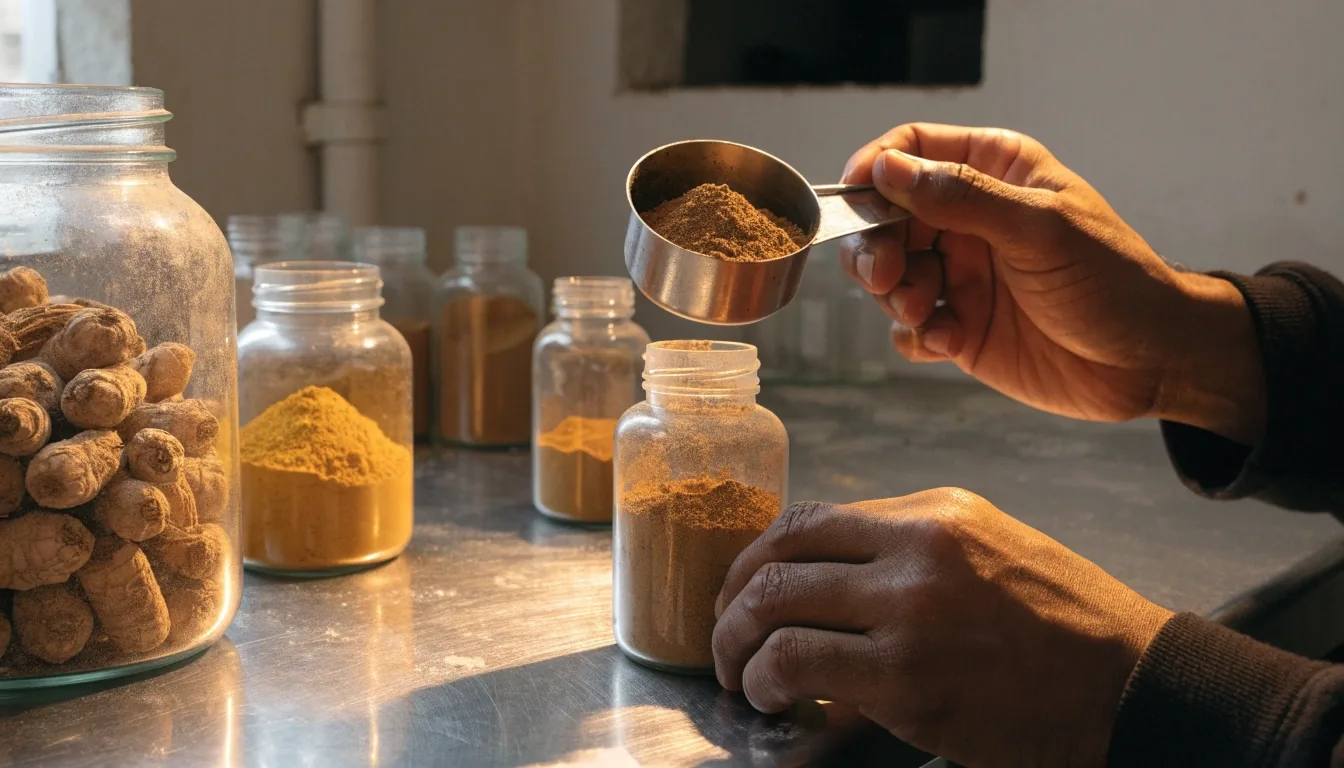
Herb, mineral and vitamin, laid out in one row
Two blends, read side by side
The easiest way to learn to read panels is to compare two formulas that look similar on the shelf. The two columns below show the same seven-line pattern you will find on most men's health bottles. One leans on herbal extracts, the other on vitamins and minerals. Neither is the right answer for everyone.
Herbal-forward blend
- Listed first
- Ginseng root, then maca and pasak bumi
- Serving size
- Three capsules a day
- Where the weight sits
- Most of the blend is the first two roots
- Micronutrients
- Zinc and vitamin D in modest amounts
- Added extras
- Caffeine or guarana may be tucked in
- Watch for
- Herb names written in a way that hides which species is used
Mineral-forward blend
- Listed first
- Zinc, magnesium and vitamin D
- Serving size
- One tablet a day
- Where the weight sits
- Vitamins carry most of the listed mass
- Herbal content
- Saw palmetto may appear lower down
- Added extras
- Fillers and binders carry no label weight
- Watch for
- Minerals stacked with other minerals that compete for absorption
The two blends above are illustrative patterns, not specific products. Use the same six questions on any bottle you pick up: what is listed first, what the serving size is, where the weight actually sits, which micronutrients are present, what else was added, and whether the herb species is named.
How to read a label in six steps
Standing in the aisle with two bottles in hand, this is the sequence that gets you to a decision without guesswork. Steps one to three take about a minute. Steps four to six are the ones most people skip.

Steps one to two
Start at the top of the panel. Read the serving size, then read the ingredient list in order. The first two names carry most of the blend's weight.
Steps three to four
Match each named ingredient to its amount. Then check whether the unit is element or compound, especially for zinc and any mineral blend.
Steps five to six
Scan the rest of the panel for added caffeine, sugar or stimulant herbs. Finally, add up what you already take so nothing is doubled.
Common questions about ingredients
These come up often enough that they are worth answering plainly before you buy anything.
Do larger amounts of an ingredient mean it works harder?
Not on its own. A bigger number on the panel only means more of that material went into the capsule. What matters is whether the amount sits in the range the ingredient is usually studied at, whether the serving size is realistic, and whether the rest of the formula supports it or works against it.
Why does the same herb show up under different names?
Local names travel faster than botanical ones. Pasak bumi, for example, is a name applied to more than one plant depending on who is selling it. A panel that prints the botanical name as well as the common one is easier to check and tells you the maker knows exactly what is in the bottle.
Can I take an herbal blend and a multivitamin on the same day?
Often people do, but the overlap is the part to watch. Zinc and vitamin D are the usual duplicates, since both appear in men's formulas and in general multivitamins. Write down what each bottle provides per day and check the totals before adding a third product to the routine.
What should I ask a pharmacist or doctor before starting?
Bring the bottle. Ask whether any ingredient interacts with medication you already take, whether the serving size suits you, and how long to try it before deciding. Supplements are not medicines and are not intended to diagnose, treat, cure or prevent any condition; a qualified professional can tell you whether one belongs in your routine at all.
Does a longer ingredient list mean a better formula?
Usually the opposite. Long lists are easy to pad with small amounts of fashionable names. A shorter panel where every ingredient carries a real amount and a stated purpose is simpler to judge and simpler to repeat month after month.
Bring your bottle and we will read it with you
If you are comparing two bottles and the panels look almost identical, come in with both. We will walk through the ingredient rows the same way this page does and help you see where the real differences sit.
Where to find us
Jl. Braga No. 45, Braga, Sumurbandung, Bandung, Jawa Barat, 40111 +62 22 423 9772 [email protected] Monday to Friday, 9:00 AM – 6:00 PMProducts discussed on this site are dietary supplements, not medicines. They are not intended to diagnose, treat, cure or prevent any disease. Speak with a qualified health professional before starting any supplement, especially if you take prescription medication.
Prostate & Urinary Wellness